

THE Acre participated in a meeting with Minister Dias Toffoli with the aim of reaching an agreement as well as distributing royalties.
Royalties are compensation paid for the extraction of natural, mineral, and water resources. The discussion should not have a direct impact on the onerous assignment.
The meeting took place at the headquarters of the National Council of Justice, with the aim of reaching a possible consensus on the distribution of funds.
The aim is for the states themselves to reach an agreement on the matter before the trial, which has modified the distribution of oil royalties.
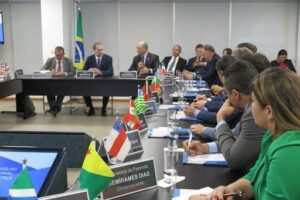
The actions are scheduled for trial in April of this year, and the person who was present representing the governor was initially the Secretary of Finance, Semírames Dias.
Division of Royalties
At the time, the decision was made with the aim of dividing the state representatives, forming two working groups with three producing states and three non-producing states.
In such a way that it remained: (São Paulo, Rio de Janeiro, Espírito Santo) another with three non-producing states (Rio Grande do Sul, Goiás and Piauí) and Acre.
Oil royalties are influenced by external factors, such as increases or decreases in production and the price of the product on the international market.
The governors are seeking an agreement that would allow producing and non-producing states to receive a percentage of royalties that would be satisfactory to all.
In principle, the representatives of the states must meet to draft the text that will be presented at the meeting next month.
Soon after, the proposal will be reported by Minister Cármen Lúcia and, subsequently, judged by the Federal Supreme Court (STF), which will decide both producers and non-producers.
The expectation is that the Minister of Economy, Paulo Guedes, and representatives of the Attorney General's Office and the Ministry of Mines and Energy.