

Understanding how compound interest works will help you make better investments with your investment fund in the long or short term. Many people fail to invest successfully due to a lack of research, but here you'll learn a wealth of information on this and other topics.
Thinking about investing? You should also think about knowledge, not just money, as the old saying goes: "knowledge is power." You might argue: But where should I start?
Using another old jargon: "from the beginning." Whatever investment you intend to make, know that the knowledge you have about the business you plan to invest in will be essential.
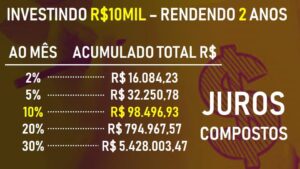
Check out the following valuable tips from financial experts on how compound interest works and how you can apply it to your personal finances.
In general terms, we can define it as follows: Compound interest is the application of interest upon interest..
How many people do you know who get into debt and can't pay it back? It snowballs out of control. Well, this never-ending debt is called compound interest. Therefore, you need financial literacy to avoid falling into these traps.
After all, what are these interests really for?
They are used to guide loans, financing and even some investments.
However, it is known that in this modality, the interest charged on a debt or to remunerate an investment also applies to the value of the added interest and not only to the initial capital, so you need to be careful!
Don't be ignorant about rates, this is a terrible idea, in addition to paying interest on the borrowed capital, you will also have to pay interest on interest.
However, when it comes to investing, using compound interest to your advantage is one of the best ways to make your money grow.
Final considerations – How can I calculate compound interest?
It's not that complicated. Just look:
Compound Interest Formula
To calculate compound interest, you will use the following formula:
M = C (1+i)t
Where:
M = Final amount
C = Capital invested
i = Fixed rate
t = Period of time.
Still have questions? We have more articles on financial education, click here and check it out
Source: economic value