

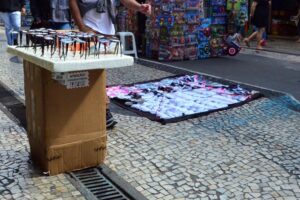
A quick walk around the city center is enough to see a visible increase in the presence of vendors. street vendors in irregular situations. Improvised benches made of cardboard, crates and screens are positioned on sidewalks and even on parts of some roads.
On them, there are various types of merchandise: fruit, socks, CDs, electronics, slippers, glasses, nail decorations, toys, umbrellas, among many other items of diverse natures.
The situation is part of a complex context, which involves, among other factors, the economic situation, the lack of public policies aimed at education and work. In addition to the disorganization of urban space, which is not restricted to Juiz de Fora, being verified to a greater or lesser degree in many cities throughout the country.
In this scenario, the first factor that stands out is the urgency of ensuring financial independence for these workers. Although he has been selling fruit and vegetables for over 20 years, street vendor Jorge Eduardo, 43, says that some time ago he had to start selling on the streets.
Unemployment
Unemployment also led Antônio Carlos Elias, 54, to seek his livelihood by working on the streets. “I worked at a company. I left and joined another one, and I was fired quickly. I couldn’t get anywhere and had to go out on the streets, do anything to survive.” According to him, he has been working like this for three years. “I come here every day and nothing is going right.
We depend a lot on others, on people’s financial situation. If they have money, they buy and we earn. That’s how we get by,” says Antônio. He points out that the ideal situation would be to have an irregular work card. “I live alone. For now, I’m managing to get by, but it’s not right, especially when the inspectors are on our case. We lose our merchandise, and we can’t work in peace. Right now, it’s helping, but it’s not safe.”
Regulars
For regular street vendors, the situation is also difficult. They understand the presence of irregular vendors, because in the past, they also had to fight to legitimize their workspace. But they see situations that go beyond the occupation of these workers. “What bothers me most today is not so much having irregular vendors, even though the city is in chaos. There are regular vendors who rent out their spaces. It has become a monopoly, there are people with two or three rented spaces. We can barely pay our taxes, while they do this and still sell the same products as us,” says one of the street vendors interviewed by the report, whose name will be withheld.
Street vendor Adilson Inácio da Silva believes that there is a lack of oversight and a more focused approach to these issues, with a focus on understanding these problems. “We have nothing against irregular workers; we have been in their shoes. These people cannot be repressed. But something needs to be done about these other issues that do not receive the attention they deserve. We understand the situation with oversight; we need them to take action on the streets.”
Street vendors and informality: part of the whole
The Brazilian labor market is strongly marked by heterogeneity. This difficult situation is not exclusive to street vendors. In fact, according to Ana Claudia Moreira Cardoso, a professor at the Institute of Human Sciences at UFJF, this reality is not isolated; it represents a dimension within the whole, which also includes the increase in the number of self-employed workers, outsourced workers, people who work from home, intermittent contracts, among other types of workers.
“From 2017 to 2019, there was an increase of around 38% in outsourcing, for example. For every six jobs that are created, one is an intermittent contract. 101 thousand jobs were created for this type of job, which is already approximately 15% of the total.
Data from the last quarter of 2019 from the National Household Sample Survey (PNAD), a survey conducted by the Brazilian Institute of Geography and Statistics (IBGE), show that the unemployment rate decreased by six percentage points, from 11.6% in October, November and December 2018 to 11% in the same period in 2019. The average annual rate decreased from 12.3% in 2018 to 11.9% in 2019. However, the professor warns that even with a result that would apparently be positive, the difficulty in offering quality jobs continues.
The average annual compound rate of labor force underutilization (which takes into account the percentage of unemployed people, underemployed due to insufficient hours worked and in the potential labor force in relation to the expanded labor force) decreased slightly, from 24.3% in 2018 to 24.2% in 2019. The total number of discouraged workers in the 4th quarter of 2019 reached 4.6 million people, around 4.2%, remaining stable in the comparison.
Insufficient earnings
Another important factor that needs to be considered, according to Professor Ana Claudia Moreira Cardoso, is the income of these people. Starting from a family unit with four people and up to three adults, assuming that in this group there is an outsourced worker and a temporary worker, for the professor, it is possible to state that the income is insufficient. In this sense, it is possible to think of precariousness in two ways: in the way of hiring and in the working hours. “There is no point in saying that it is formalized, if it does not provide conditions. In the capitalist mode of production, the individual depends on work, preferably a quality job, to survive. The biggest contradiction is having a system that tells you that you will only survive with a job of minimum quality, which does not offer you this job.”
Thus, the lack of social welfare will make people, as the professor says, look for whatever they have, because they would have no other options. “The data shows that those who lost the most income were those in bracket one, people who earn up to R$1,600. Other brackets, especially those who earn more than R$1,200, managed to recover a little.” As the professor explains, the brackets with the lowest income are those that spend the most on food, which was one of the items with the biggest price increase. The result is that families with lower incomes are earning less and spending more on basic necessities. With more economic measures under discussion, such as the Economic Freedom Provisional Measure, new changes in work are already planned, which could further disrupt these families.
Consequences
Based on all these indicators, unemployment rates are unlikely to increase, according to Ana Claudia, but the jobs that will be created, on the other hand, are not of the quality that would be desirable. “This not only disrupts families, but also creates greater pressure on the State. Because people start to get sick. While some work much less than they need to, others work very hard and end up getting sick,” she points out.
The solution she believes to this situation is popular pressure. “It’s the only way. There’s no other way. You can’t solve this individually.” To do this, however, she emphasizes that institutions need to be more active.