

In the Araguaia Paraense region, eight families settled under the agrarian reform of Tucumã, should receive, in March, R$ 400 thousand to implement Agroforestry Systems (Safs) for farmers.
In order to promote the socioeconomic and environmental value of cocoa, the flagship of family farming in the municipality, and a product also exported to Bahia, where it is transformed into chocolate.
As the cocoa production chain currently generates 64 thousand direct jobs and another 255 thousand indirect jobs in To, according to data from Adepará.
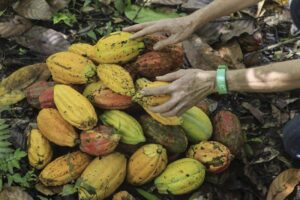
Production
The income produced with fruit in the State reaches R$1,400,000 per year, thus Pará has producing regions: northeast, south, west, islands region and Transamazônica.
Thus, the individual projects represent R$ 50 thousand each and indicate the intercropping of cocoa with banana, for temporary shading and use of the harvest.
To maintain performance, technicians visit properties and, on these occasions, evaluate the plantation, monitor and register farmers' harvests.
Pronaf Floresta, part of the National Program for Strengthening Family Farming in the Forest, a program focused on sustainability and ecology, has been implemented more quantitatively.
In fact, the R$ 400 thousand resources will be used to replace the costs of Safs, which are already being implemented in at least six different neighborhoods.
According to the head of the local Emater office in Tucumã, agricultural technician Ronnie Peterson Santos, the expectation is to diversify activities.
Some areas are degraded, and the SAFs serve as a recovery tool. The results are positive on all fronts, concluded technician Ronnie Santos.
However, Pronaf Floresta, a line focused on sustainability and ecology, has been activated more quantitatively in Tucumã since last year.
The objective is to promote sustainable agriculture, sustained, inclusive and sustainable economic growth, full and productive employment, and decent work for all.
The product is exported to Bahia, where it is transformed into chocolate for sale.