

A national pioneer in wind energy production, Ceará could receive the first wind farm offshore (installed at sea) in Brazil. Last Wednesday (11), the Brazilian Institute of Environment and Renewable Natural Resources (Ibama) held, in Fortaleza, the first public hearing on this type of enterprise in the country.
On the occasion, the Environmental Impact Report (Rima) of the “Parque Eólica Offshore Caucaia” was presented, a project by BI Energia, a company with Brazilian and Italian capital.
According to Lúcio Bonfim, a partner in the company, the expectation is that by July of this year Ibama will issue its opinion on Rima and grant the preliminary license for the project.
"After that, we'll develop the executive project, which should take about twelve months. And then we'll apply for the installation permit. From there, with all the permits in place, it will take two years to build the project," estimates Lúcio Bonfim.
In total, the complex is expected to require an investment of €1.166 billion, equivalent to R$6.1 billion. According to Bonfim, the resources will come from partner companies, investors, and investment funds.
59 wind turbines
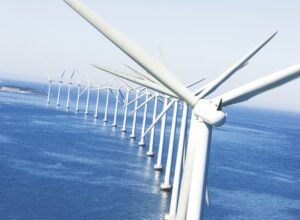
"Our company, which operates in Italy, has been developing projects in Brazil for over 10 years," he says. And although the investment volume is greater than that of conventional wind farms, the expected return on investment is seven years, a similar timeframe to traditional onshore projects. According to the BI Energia report, the complex could supply up to 30% of Ceará's energy consumption needs. The project calls for the installation of 59 wind turbines, 48 of which will be offshore, capable of generating a total of 576 megawatts (MW), and another 11 with 2 MW of individual power (22 MW total) at the ends of 11 breakwaters (coastal structures similar to groynes) that will be built along the Caucaia coast.
The predicted power for the “Caucaia Offshore Wind Farm” corresponds to approximately 30% of all wind power currently installed in Ceará.
Opportunities
As a form of environmental compensation for the plant's installation, BI Energia's project includes the construction of breakwaters. The company responsible for the construction, through a subsidiary, will be able to grant multi-year concessions to the marine areas within the breakwaters themselves, allowing these marine areas protected by the breakwaters to be economically exploited. In addition to the economic potential generated by the use of the breakwaters, Bonfim emphasizes that the intervention should protect the beaches of Caucaia, Icaraí, Tabuba, and Cumbuco from the advancing sea. "These 11 breakwaters will solve the erosion problem in Caucaia, preventing it from reaching São Gonçalo do Amarante," he says.
Efficiency
According to Bonfim, because they allow the construction of larger towers, equipped with large generators, offshore wind farms have a productivity efficiency rate above 60% of total capacity, while plants installed on land do not exceed 45% of utilization.
"Furthermore, at sea, you have much stronger wind conditions than on land. Large machines operating on land have 4 MW of power, while at sea, you can deploy a 12 MW machine," the businessman points out.
Potential of Ceará
Therefore, engineer Jurandir Picanço, president of the Ceará Renewable Energy Sector Chamber (CS Renewables), assesses that the state's offshore potential is "gigantic." "In Ceará, it was estimated at 117 GW. This is greater than the onshore potential (94 MW). The wind quality is better, and the wind turbines, being larger, are more efficient. The investment is higher," he notes.
Therefore, regarding the viability of offshore projects, Picanço says it depends on each project. "Globally, offshore wind energy is expected to increase 15-fold in the next two decades, transforming it into a US$1 trillion business. Although the global offshore wind market grew by almost 30% per year between 2010 and 2018, benefiting from rapid technological improvements, the best locations for these projects could provide more than the total amount of electricity consumed worldwide today," he says.
Professor and energy consultant João Mamede Filho believes that land for coastal power plants will become scarcer. However, the sector is likely to shift generation offshore, and in this context, Ceará thus has a competitive advantage over other states due to the shallow depth of the seabed available for exploration.
"Thus, offshore energy is already common in Europe due to the lack of land (for installing equipment). However, the issue still weighs on the cost of these projects, which is much higher than onshore ones," highlights the professor and energy consultant.
"In any case, Brazil should expand its production offshore, and we, in Ceará, have the advantage of shallow water, which helps make projects viable. Furthermore, regarding the electrical system, we don't have connection problems on the coast."
Project
Thus, the construction of offshore parks took shape with Senate approval at the end of last year. Although the bill regulating this generation modality has been approved, the projects will now depend on the upcoming energy auctions launched by the Federal Government.
In the implementation zones determined by the text approved in the Senate (between 22 and 370 kilometers from the coast), the depth recorded in Ceará would be more favorable for this type of investment, being around 18 meters.