

With the country's slow economic recovery and high unemployment rates, Bahians are looking for creative alternatives to survive as entrepreneurs.
There were five women in the waiting line, all comfortably seated. Two eyebrow designers and three manicurists showed skill and haste.
Without a doubt, the scene described would be that of a beauty salon like any other, if it were not located on Avenida Sete de Setembro.
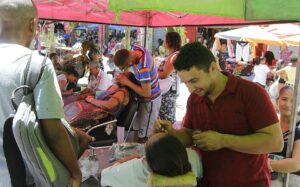
In the center of Salvador, Fabio, who owns a salon, and his troupe, trained by him, were under two improvised awnings.
In effect, they brought joy to customers who didn't have the time or money to go to a salon with walls and air conditioning.
With Brazil undergoing a slow economic recovery, or with the prospect of growth, not to mention the lack of employment that affects 12.4 million people.
Informality
Since the Bahian, like any unemployed Brazilian, has been forced to find a way to survive, although Fábio is not even from Bahia, the region of North East.
A year ago, Fabio came from Aracaju, where he was born, to expand his market, even though he spent 15 years working in a salon in the same way.
Once he compared “But, there I didn’t work for myself. Here, I’m the one in charge”, said Fábio, now without revealing how much he earns per week.
Their employees do not have any employment relationship, meaning the agreement is that 30% of what they earn has to go into the “boss’s” pocket.
Fábio, also an eyebrow designer, learned the trade with Gledson do Mutirão, the hairdresser and former councilman of Aracaju known for organizing entrepreneurial collectives.
They then became his informal employees, Matheus Santos Oliveira, an employee, said that it is very worthwhile even informality that before sold orange juice on the street.
According to data released by the Brazilian Institute of Geography and Statistics (IBGE), in October last year, the country had 38.8 million informal workers.
Just to give an example, informal workers represent 60% of the employed population in Bahia, and for them, advertising is by word of mouth.
In short, in times of crisis, opening your own business has been an alternative to achieving financial independence and reducing unemployment.