

A survey by FGV says that economic stimulus communicated so far represents only 5% of GDP – while in other countries this value is close to 20% of Gross Domestic Product.
The measures announced by the federal government to protect both the population and businesses from the undeniable blow that the current coronavirus pandemic has dealt to the national and global economy, total to date more than R$1,400,000 billion.
However, despite the number of digits, economists point out that it is still a paltry movement compared to those measures adopted in other countries.
Faced with the risk of the country returning to recession, experts warn that the measures and volume of resources announced are insufficient to protect the economy and citizens.
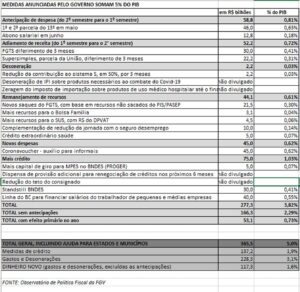
Manoel Pires, an economist at the Fiscal Policy Observatory of the Getúlio Vargas Foundation (FGV), conducted a survey that indicates that the economic stimulus announced so far by the Bolsonaro government represents 5% of the country's GDP (Gross Domestic Product).
And, once the credit measures are discounted – loans that the government is facilitating, but that companies will have to pay back in the future – , the value drops to R$1.4T 228 billion, or the equivalent of R$3.11T3 of GDP.
- In Germany, for example, government spending to tackle the coronavirus crisis has already reached 35% of GDP.
- Spain and the United Kingdom, 17%
- France, 15%;
- And in the US it is already approaching 10%.
According to the survey.
In the United States, the government and parliamentarians reached an agreement on an aid package worth more than US$2.2 trillion.
Graph showing measures announced by countries (as a percentage of GDP)

The calculation also takes into account the project approved by the Chamber of Deputies, which provides for the payment of R$ 600 to informal workers for 3 months. In addition to the new emergency credit line of R$ 40 billion for small and medium-sized companies announced this Friday (27).
Although the payment of R$600.00, totaling R$45 billion, is the largest expenditure in "new money" among the announced measures, Pires' study says it represents merely R$0.621.3 billion of GDP.
Summary of measures, value in billions and what they represent as a percentage of GDP:
For more information on the economy and to stay up to date with the impacts of the coronavirus pandemic on the national and global economic scenario, access.